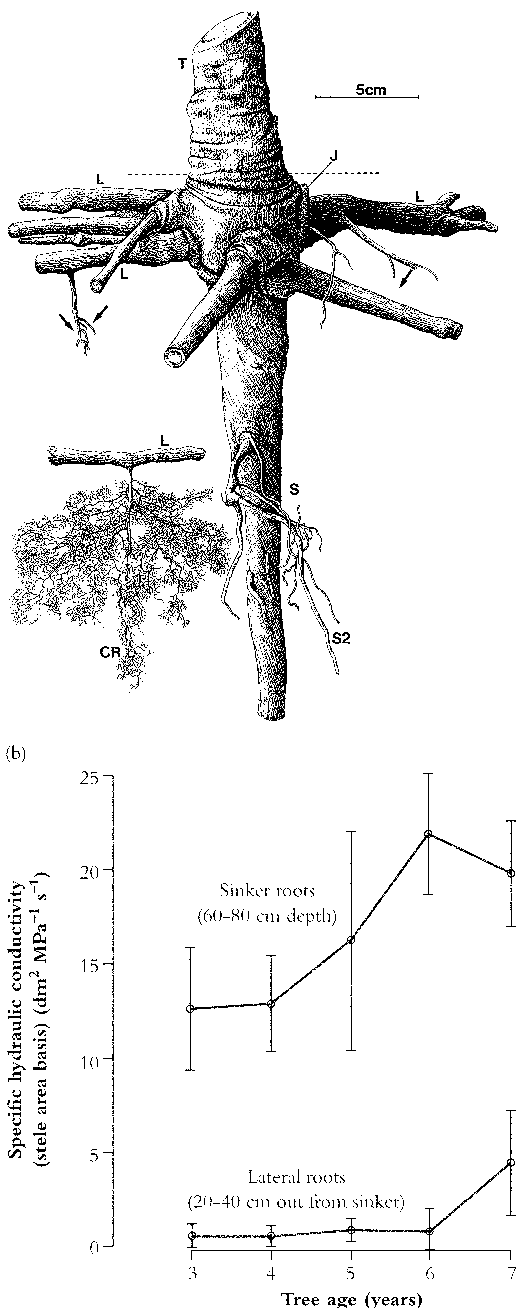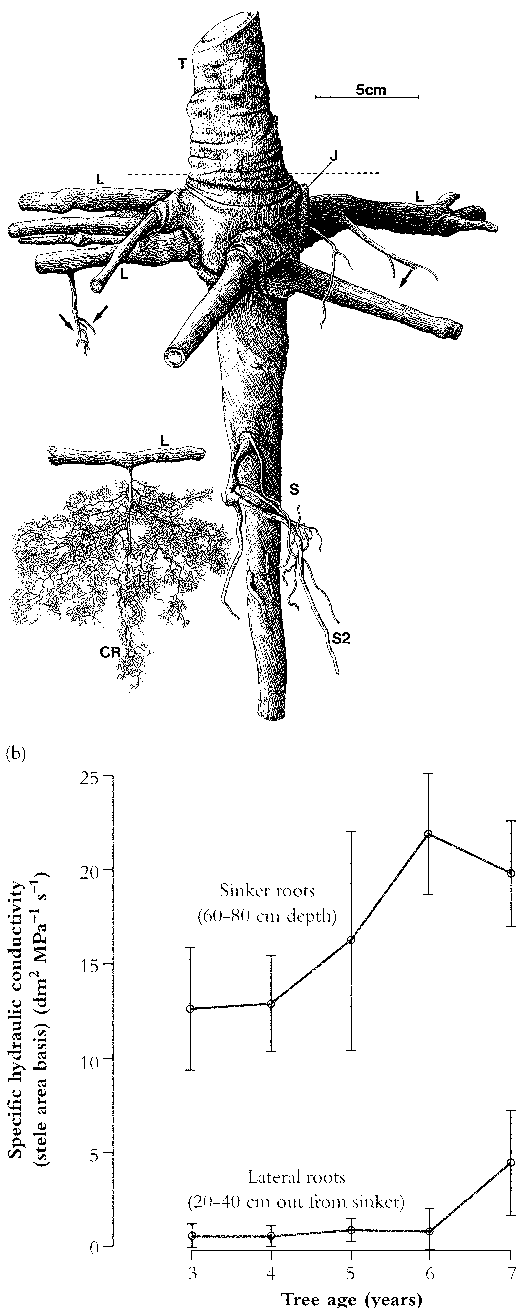
Figure 3.2 (a) Dimorphic root system of a six-year-old Banksia prionotes tree growing in Yanchep, Western Australia, on a deep sand with dominant winter rainfall. The lower trunk (T) is connected through a swollen junction (J) to the root system. A system of lateral roots (L) emerge horizontally from the junction, some bearing smaller sinker roots (arrows). Other laterals give rise to ephemeral cluster roots (CR) as described in Case study 3.1. The remainder of the root system comprises a dominant sinker root (S) which gives rise to smaller sinkers (S2). (b) Sinker roots penetrate up to 2.6 m into the sand and extract water through a low-resistance (high hydraulic conductivity) xylem pathway. Xylem in lateral roots is significantly narrower, raising axial resistance to water flow by at least one order of magnitude (Based on Jeschke and Pate 1995; reproduced with permission of Journal of Experimental Biology)