
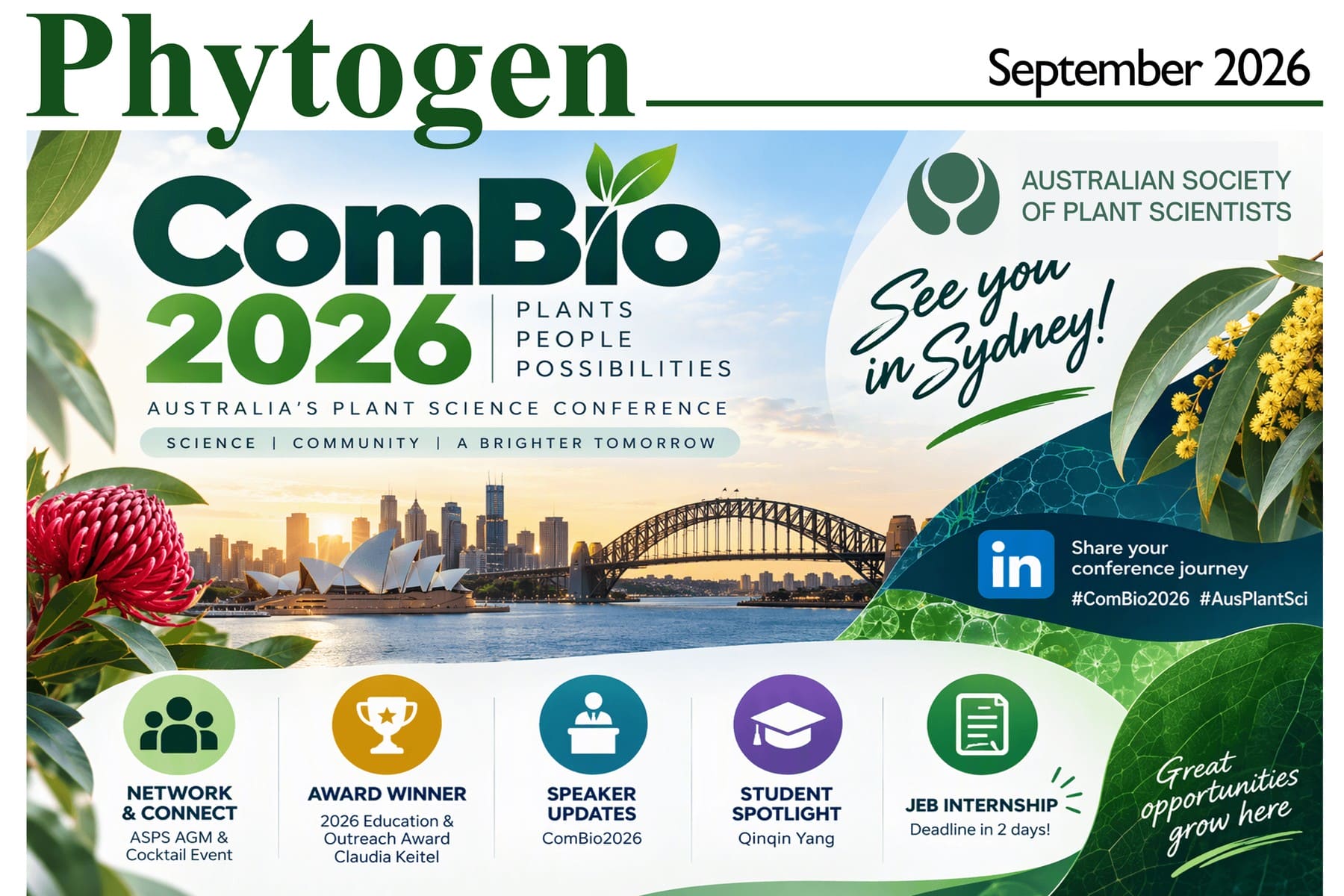
This will be a short and sweet issue, as our annual conference ComBio2026 is around the corner. If you are heading to Sydney for the conference, we wish you a great time – don’t forget to connect with ASPS members and attend our AGM in person on September 30th – followed by the ASPS cocktail event hosted at Hay Street Market (Main Quarter). If you are on LinkedIn, using the hashtag #Combio2026 or #AusPlantSci will allow us to promote your conference involvement and your research. In this issue, we spotlight the 2026 Education and Outreach award winner, Claudia Keitel, provide speaker details for ComBio and feature the contribution of our student representative Qinqin Yang.
There is also a call out for Editorial Internship program at the Journal of Experimental Botany. Deadline is in 2 days so get in for this amazing opportunity if you are keen.
Connect with ASPS on social media: LinkedIn: Australian Society of Plant Scientists; BlueSky: @asps-oz.bsky.social
Phytogen is a community-driven newsletter, and we welcome contributions from ASPS member students, early- and mid-career researchers, and established scientists at any time. We are always looking for: Student or lab research highlights, conference or workshop reports, opinion pieces and perspectives and upcoming events, webinars, and symposia suggestions
Contributions can be sent anytime to Phytogen co-editors Raz ([email protected]) or Sneha ([email protected]).
ComBio 2026
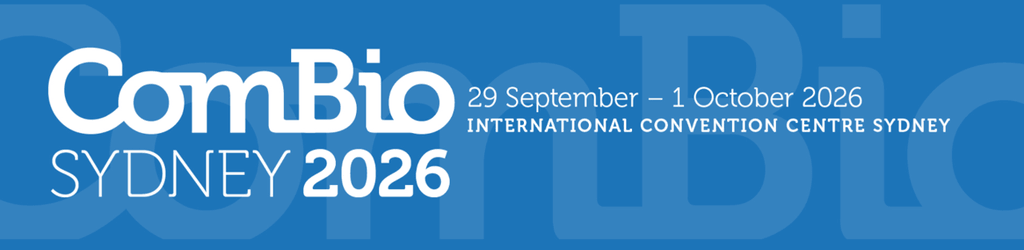
Tickets for the ASPS cocktail event are also now available at these links:
https://www.combio.org.au/social-program
https://www.asps.org.au/asps-2026-cocktail-evening
The conference program will showcase cutting-edge research across a broad spectrum of disciplines, including:
Cell and Developmental Biology
Biochemistry and Metabolism
Proteins, Peptides, and Structural Biology
Plant Biology
RNA
‘Omics and Systems Biology
Education
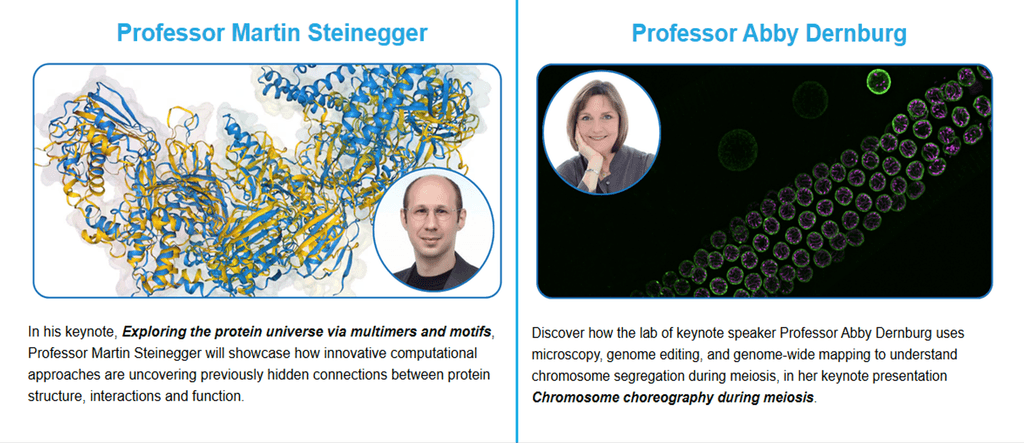
We are delighted to share the graphical abstracts from our outstanding Keynote Plenary Speakers, offering an exciting glimpse into the ideas, insights, and discoveries they’ll be bringing to the conference.
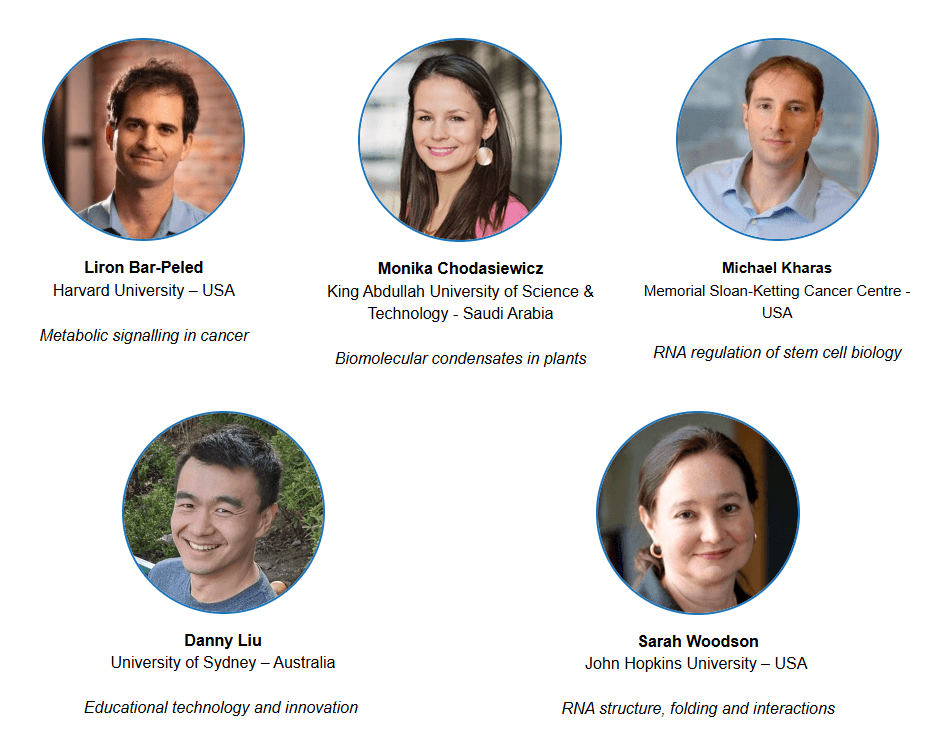
Keynote plenary speakers:
Plenary speakers

2026 ASPS Award Winners Spotlight
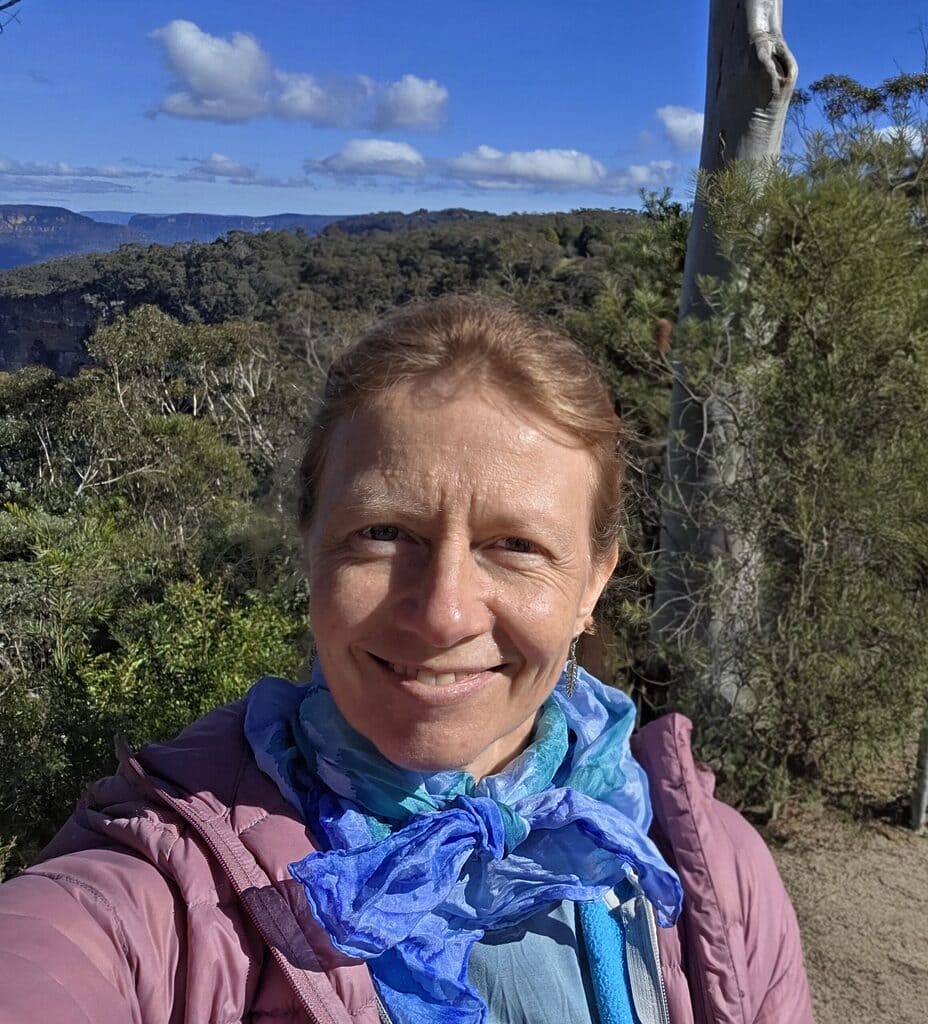
2026 Education & Outreach Award
A/Prof Claudia Keitel
University of Sydney
Claudia Keitel is a plant physiologist who completed her PhD in tree ecophysiology at the University of Freiburg in 2004. She subsequently undertook postdoctoral research at the Australian National University, where she used stable isotopes to trace water and carbon flows in plants. She later continued her work at UNSW and the University of Sydney, investigating how Australian Eucalyptus species function under water-limited conditions. Since 2011, she has been based at the University of Sydney.
Claudia’s research integrates plant physiology, soil and agricultural science, and stable isotope approaches to understand how carbon, water and nutrients move through plant-soil-microbe systems. Her work has advanced understanding of plant water use, carbon allocation, nutrient cycling, soil carbon dynamics, and ecosystem responses to environmental change. In early 2026, Claudia led the biennial Stable Isotopes in Biosphere Systems (SIBS) Workshop at the University of Sydney. The week-long program brought together leading isotope researchers and participants from across Australia and overseas for intensive training in isotope theory, analytical techniques, and hands-on experiments spanning plant biology, ecology, agriculture, hydrology, and environmental science.
More recently, Claudia’s interests have expanded into Australian native grains. Her work has examined the structure, nutritional composition, and processing characteristics of native grain species, identifying valuable traits such as high protein and dietary fibre contents. This research is helping to build the scientific foundations for emerging native grain industries while recognising the cultural significance of these species and the long history of Indigenous stewardship.
The native grains research has also informed the design of an immersive first-year practical that integrates plant science, agricultural science, and Indigenous knowledge systems. The practical explores plant and seed structures alongside current and traditional grain-processing techniques and flatbread making and tasting. Students engage with Gamilaroi knowledge holders and critically evaluate the opportunities and challenges associated with a future native grains industry. Through hands-on learning and guided discussion, students develop scientific understanding, cultural competence, and a deeper appreciation of Indigenous knowledge systems and connection to Country.
Student Representative Contribution
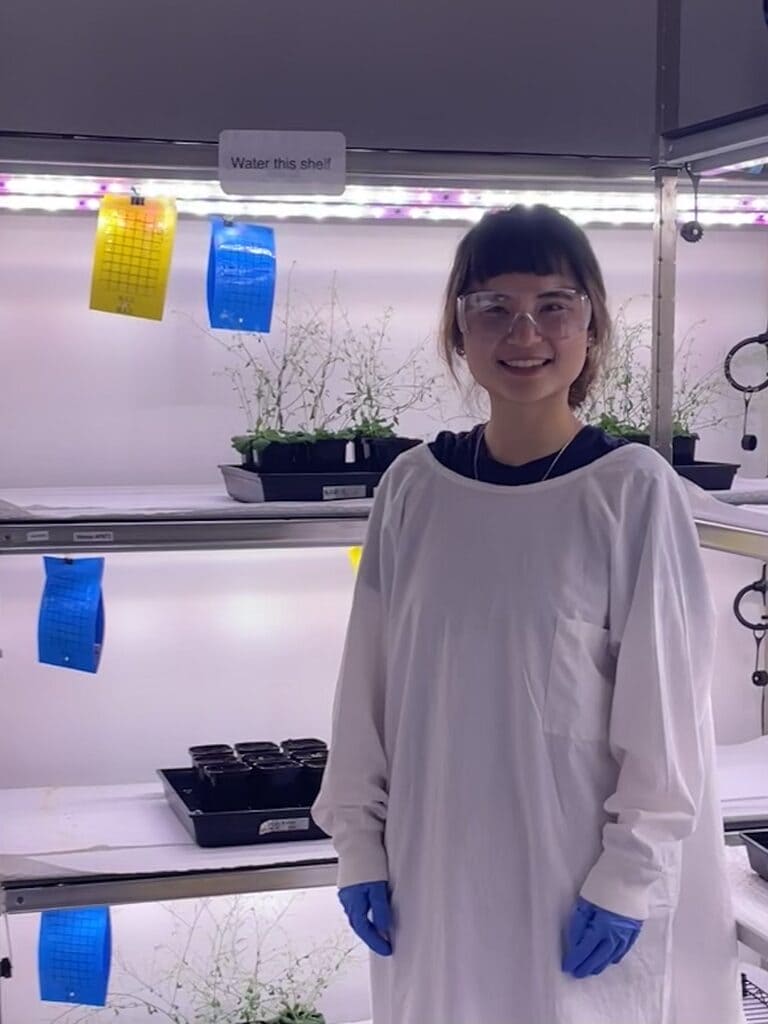
Qinqin Yang
PhD candidate, the University of Sydney
ASPS Student Representative for NSW (2025-2026)
Hi everyone! I’m Qinqin Yang, a third-year PhD student at The University of Sydney. My research focuses on developing nanoparticle-based delivery platforms to introduce genetic materials into pollen grains.
Pollen is an important and fascinating target for plant biotechnology. As part of plant reproduction, pollen provides a potential pathway for delivering genetic materials into plant reproductive cells and could open up new possibilities for plant modification and crop research. However, introducing materials into pollen is challenging because of its unique cellular structure and biological barriers, and developing effective delivery strategies remains an important area of research.
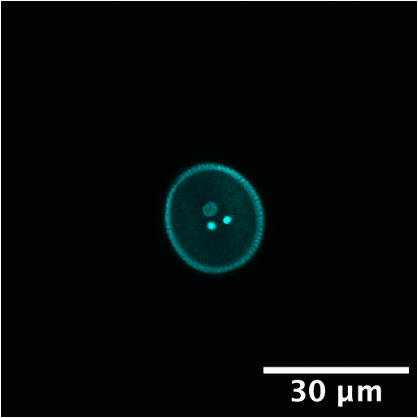
My PhD research therefore focuses on exploring how nanoparticles can be used as a delivery platform for genetic materials in pollen. By using nanoparticles as carriers, I am interested in exploring whether genetic materials can be effectively introduced into pollen and whether this approach could provide new opportunities for plant biotechnology.
One of the motivations behind this research is to explore new approaches that could complement or provide alternatives to conventional plant modification methods. Developing effective delivery strategies through pollen could provide a potential route for introducing genetic materials into plant reproductive cells, particularly in crop systems where conventional transformation approaches can be challenging.
If you’re interested in this area of research, I’d be more than happy to have a chat! Please feel free to get in touch with me on LinkedIn.
Recently, I had the opportunity to attend the 28th International Congress on Sexual Plant Reproduction, and it was a fantastic experience. I had the opportunity to introduce my research, discuss my poster with researchers, and receive valuable feedback and suggestions. What I particularly enjoyed was being able to discuss my research with people who approach plant reproduction from different perspectives. Their questions and ideas encouraged me to think more deeply about my work and gave me new perspectives on how I can further develop my research.
The conference also gave me a much stronger sense of the wider plant science community. It was inspiring to meet so many researchers who are enthusiastic about plant research, and to see how different areas of research can connect with one another. I am very grateful to everyone who took the time to discuss my research, share their knowledge, and provide suggestions. The experience has given me more confidence in my research direction and motivated me to continue exploring nanoparticle-based delivery in plant and crop pollen.
I am also very grateful for the opportunity to be a student representative for the Australian Society of Plant Scientists and to have contributed to the March 2026 edition of Phytogen. The special issue celebrating women in Australian plant science was created as part of the International Women’s Day celebrations and was particularly meaningful to me. It was wonderful to see and learn about so many inspiring women scientists working across different areas of plant science, and to see the strength and diversity of the plant science community.
I’m now looking forward to attending ComBio2026, where I’ll also be helping out with some volunteer activities as a student representative. I’m excited to meet more plant scientists, share my research, and build new connections within the plant science community.
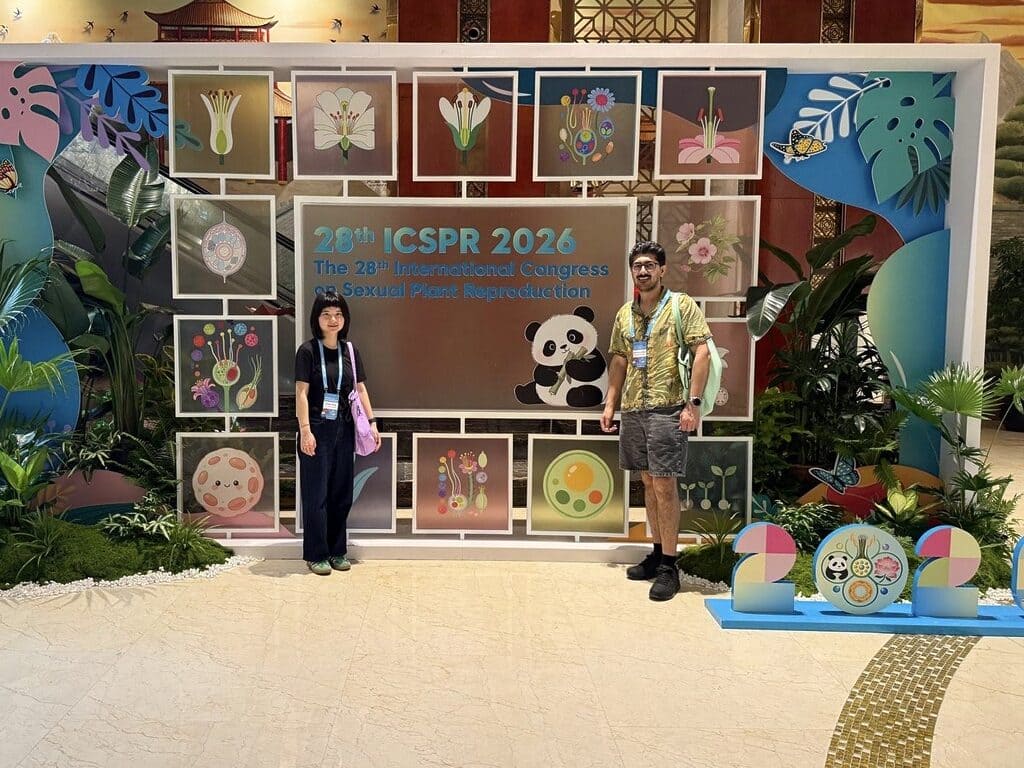
Legend of the figure: (left) Qinqin Yang and (right) Farhad Masoomi-Aladizgeh, Genetics and Molecular Biology Discipline Representative
Opportunities
Conference, Webinar, Symposia,
Soil Science Australia Conference 2026
The Soil Science Australia Conference 2026 will be held in Perth, bringing together researchers, practitioners, and students working across soil health, agriculture, and environmental systems.
This is a great opportunity to share research, build networks, and engage with the latest advances in soil science.
📅 1–5 November 2026
📍 Boorloo (Perth)
🎟️ Early bird registration is now open — don’t miss the discounted rate (check the website for closing date details).
👉 More information and registration: https://www.soilscienceaustralia.org.au
Internship
Opportunity for Plant Science ECRs at JXB!
The Journal of Experimental Botany is inviting applications for the fifth round of their Editorial Internship program. The aim of these internships is to provide early career researchers with experience of scientific publishing from the editorial side, as an opportunity for career development as a researcher, or with a view to a career in scientific publishing.
The successful applicants will be involved in quality control and scientific assessment of 6-12 submitted manuscripts under the mentorship of JXB’s Editors and will be fully supported by the JXB editorial office. They will receive guidance on how to review a manuscript and also help communicate the journal’s most exciting content and new developments in the field of plant science by writing 1-2 Insight articles to be published in the journal.
These part-time internships will run for one year, starting on January 1st 2027, and the journal will offer a small honorarium and free SEB membership for one year to each Editorial Intern. All editorial work associated with the internships will be conducted online.
The deadline for applications is 30th September 2026, and the call is restricted to researchers with 2–8 years postgrad/postdoc experience, excluding periods of leave.
For more information, visit the dedicated webpage. Any questions can be directed to the journal’s Managing Editor: [email protected].
Get Involved with ASPS
Life & Corresponding Membership
Life Membership
Life Membership of the Australian Society of Plant Scientists recognises an outstanding and sustained contribution to the Society by a longstanding ASPS member who, through their professional activities, has substantially enhanced the international profile of Australian plant science research.
Nominations for ASPS Life Membership can be made at any time to the Honorary Secretary (Mary Byrne [email protected]). A one-page summary addressing the above criteria must accompany the nomination.
Corresponding Membership
Corresponding Membership of the Australian Society of Plant Scientists recognises overseas colleagues, with a high profile of research achievement in any field of plant science, who have a strong track record of successfully contributing to and promoting plant science research within Australia.
Nominations for ASPS Corresponding Membership can be made at any time to the Honorary Secretary (Mary Byrne [email protected]). A one-page summary addressing the above criteria together with a curriculum vitae of the applicant must accompany the nomination.
Editors’ Note
Thank you for reading!
Thanks for your continued support for Phytogen and ASPS to advance the Australian plant science community. The research we spotlight in this issue is a great example of the multifaceted aspect of the Australian plant science research landscape, from Claudia’s work linking across disciplines of plant physiology, soil and agricultural science, and stable isotope approaches to understand how carbon, water and nutrients move through plant-soil-microbe systems, to Qinqin’s research developing nanoparticle-based delivery platforms to introduce genetic materials into pollen grains. If you are heading to Sydney for Combio, we hope your time is engaging and opens up new collaborations. We will be featuring key events from the conference over the next few months and welcoming a new cohort of ASPS discipline and student representatives for 2026-2027.
Newsletter written & edited by Razlin Azman
We thank the following members for their contributions to this issue: Claudia Keitel and Qinqin Yang, and Mary Byrne.
We also thank the ASPS executive for their continued support of Phytogen.