Welcome to the August 2025 edition of Phytogen!
This month, we present cutting-edge research contributions from our Environmental Ecophysiology discipline representative. Dr. Kristine Crous shares her pioneering work on in-situ leaf warming experiments in tropical rainforest canopies, revealing critical insights into climate adaptation limits. With the ASPS Conference 2025 in Adelaide approaching rapidly, we provide essential registration, conference dinner and abstract submission information. We encourage all members to take advantage of early bird registration rates and conference travel grants.
You can stay connected with ASPS on social media on the following platforms:
LinkedIn: Australian Society of Plant Scientists; BlueSky: @asps-oz.bsky.social
Join the conversation using #AusPlantSci and #ASPS2025 (for the conference). Tag us in your posts to help us promote your science! Phytogen contributions will also be featured on our social media pages.
We welcome contributions from students, E/MCRs and established researchers at any time for publication in Phytogen. It is free and a great way to give your research profile a boost and share your findings! You can send your contribution to our editors Raz ([email protected]) or Lucas ([email protected]).
ASPS Conference 2025
Registrations & abstract submission are now open!
Just a reminder, the ASPS conference will be held this year in Flinders University in beautiful Adelaide. Save the date for 24-27th November.
You can find all relevant info about the conference, including registration, abstract submission, accommodation and more on the site: ASPS annual conference. If you have any questions about the conference please contact Dr. Crystal Sweetman at [email protected].
Abstract submissions
Close on 3 October 2025. Don’t forget to use the abstract template provided when submitting your abstract.
Registration
Early bird rates end on 3 October 2025. Even if you are not a member of ASPS, you can sign up and benefit from discounted rates when you register.
Please note that registration will take you to a Flinders University page: https://www.asps.org.au/asps-annual-conference
Conference dinner
The social committee have also organised a wonderful conference dinner at the National Wine Centre of Australia, right next to the Adelaide Botanic Gardens. With beautiful food and wine to share with colleagues and friends, it will be an evening to remember. Tickets available for purchase at the conference registration page.
Accommodation deals
Please note that the conference will be at the Bedford Park campus of Flinders University. Flinders University has several campuses in Adelaide so don’t get caught out at the wrong campus! Accommodation offers can be found here: ASPS 2025 accommodation
Check out these social events for the conference
The ASPS 2025 social committee has put together an afternoon of social and sightseeing activities on Day 2 of the conference (Tues 25th Nov)! Tickets for these activities will be available soon, please see below for more information.
Mt Lofty gardens: enjoy a guided tour of the stunning Mt Lofty Botanic Gardens and a visit to the equally beautiful Mt Lofty summit. Cost ~$10 per person. More info here: https://www.botanicgardens.sa.gov.au/visit/mount-lofty-botanic-garden ; https://www.mountloftysummit.com/
Waite Campus: discover what the Waite has to offer, including guided tours of The Plant Accelerator, Waite Arboretum and Waite Campus Winery. Cost ~$10 per person. More info here: https://www.thewaite.org/#
McLaren Vale wineries: experience two of McLaren Vale’s iconic wineries (d’Arenberg and Wirra Wirra), with a tour and tastings. d’Arenberg also features a Salvador Dali exhibition (available at an extra cost of 10$). Cost ~$70 per person. More info: https://mclarenvale.info/
*Note: Transport included. Costs are approximate. Numbers may be capped based on tour capacities.
Support the ASPS 2025 conference
Help us spread the word in your university or research group about the upcoming conference. You can use the email banner below to promote the conference. We will be circulating posters that you can print or send to our colleagues who might be interested in the conference, or being part of ASPS.

Is Your ASPS Membership Up to Date?
ASPS membership connects you with Australia’s plant science community and provides valuable professional development opportunities. Student memberships are available at reduced rates.
Membership Benefits:
- Access to a network of plant scientists across Australia
- Discounted registration for conferences
- Eligibility for ASPS awards and travel grants
- Regular updates through Phytogen newsletter
Become a member, check and/or renew your membership status: Become a Member — Australian Society of Plant Scientists
Environmental & Ecophysiology Discipline Representative Contribution
Heating leaves in the canopy of a mature tropical rainforest
by A. Prof. Kristine Crous, School of Science, Western Sydney University
Warming experiments have been mostly occurring on seedlings in small glasshouses but imagine being able to do it on large trees in natural settings? This is what I set out to do, coming up with a design to heat leaves in the canopy with good feedback controls. I was particularly interested in the physiological changes that would ensue in the leaf and to what extent leaves would acclimate to a sustained heating signal, here a continuous 4°C warming, in natural settings.
Moreover, tropical rainforest have adapted to thermally stable conditions over the past ten thousand years and therefore are thought to have less ability to acclimate to new, warmer temperatures. They are sensitive to warming because they are operating close to their temperature optima (of photosynthesis) and any further warming may be detrimental rather than beneficial.
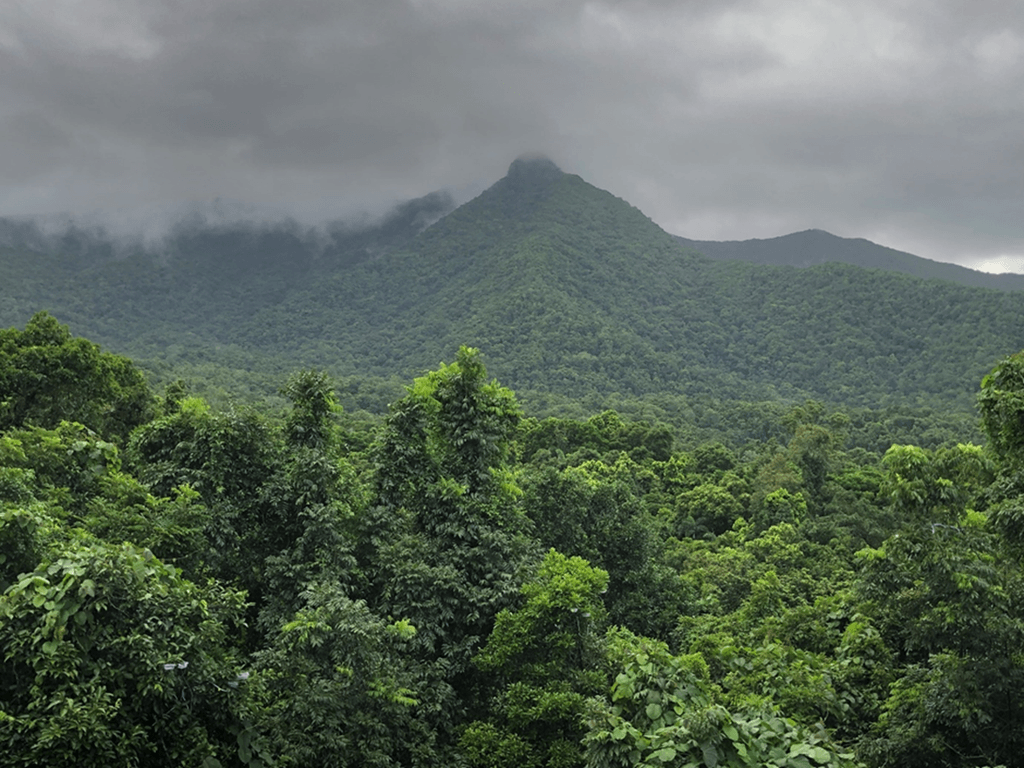
Figure 1. Natural settings in the tropical rainforest of the Daintree region in far North Queensland (https://www.jcu.edu.au/daintree )
After an initial test run in a Eucalyptus woodland (see Crous et al. 2023 ) the experiment was deployed in 2021 in the Daintree Tropical rainforest, heating a total of 22 leaves across 4 species, and ensuring a similar set up for control leaves that were not heated (Figure 2). We deployed custom-made takeaway containers with fishing wire to hold the leaf at a specific distance from the heating wire (and avoid scorching). These containers were open with the wind freely moving through, and no differences in photosynthesis rates between boxed control reference leaves and non-boxed leaves. The boxes were attached to a frame that would be connected to the branch via cable ties. Leaf thermocouples were installed to measure the temperature difference between the boxed warmed and reference leaves, with a feedback control to keep the target warming as constant as possible. At the ground floor, all the cables would run from the tree stems to a central datalogger (Figure 3), which kept track of temperature differences between heated leaves and reference leaves. The total amount of cable set up in the forest was around 2 km across 11 trees.
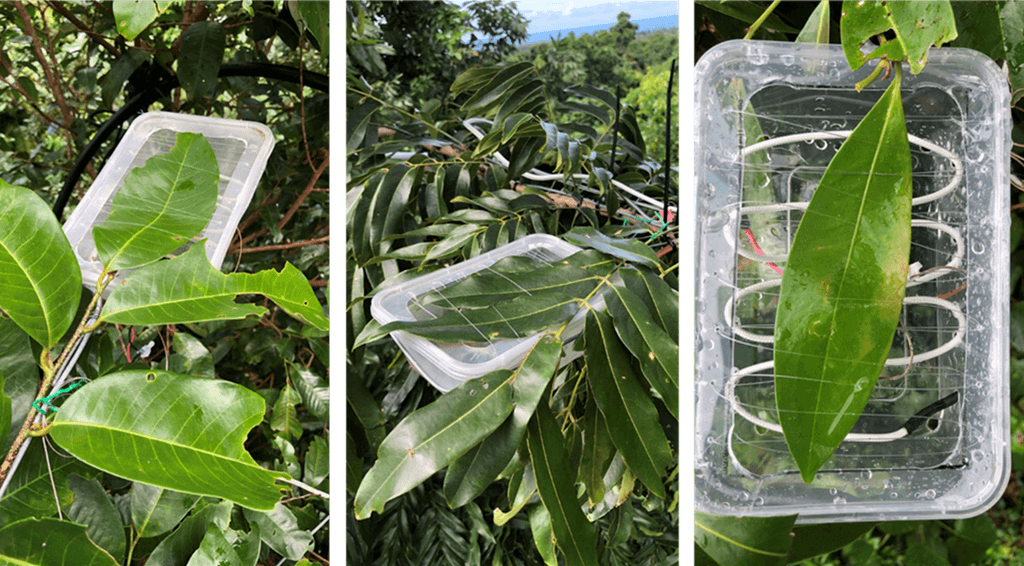
Figure 2. Three of the four species in their boxes, Myristica globosa (left), Castanospermum australe (mid) and Endiandra microneura (right panel). Heated boxes are indicated via the presence of the white heating wire, which is not present in the non-heated reference boxes. The metal frame and attachment to the branch can best be seen in the left panel.
Originally, this heating experiment in the tropics was planned to run for four months, but COVID reared its ugly head and due to border closures, the experiment ended up running for eight months with measurement campaigns in two seasons. One set of measurements was taken in August and a second set was taken in December during the hottest period of the year.
Figure 3. The central datalogger in the tropical rainforest, outside (left figure) and inside (right figure). The lights indicate the warming system in action.
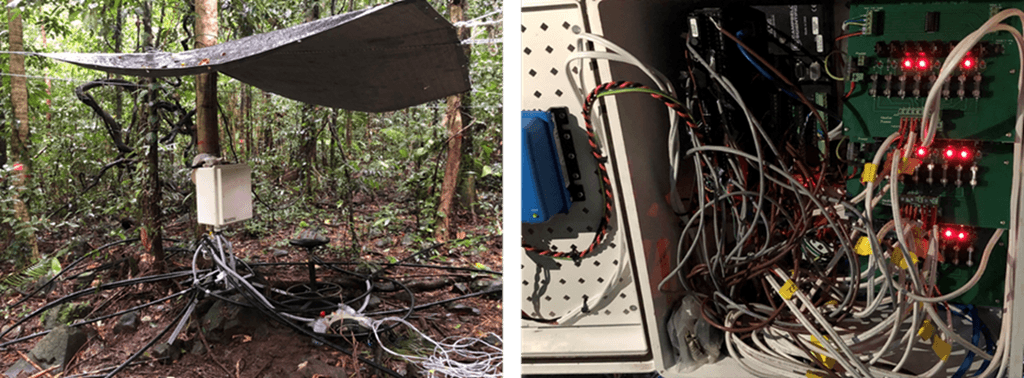
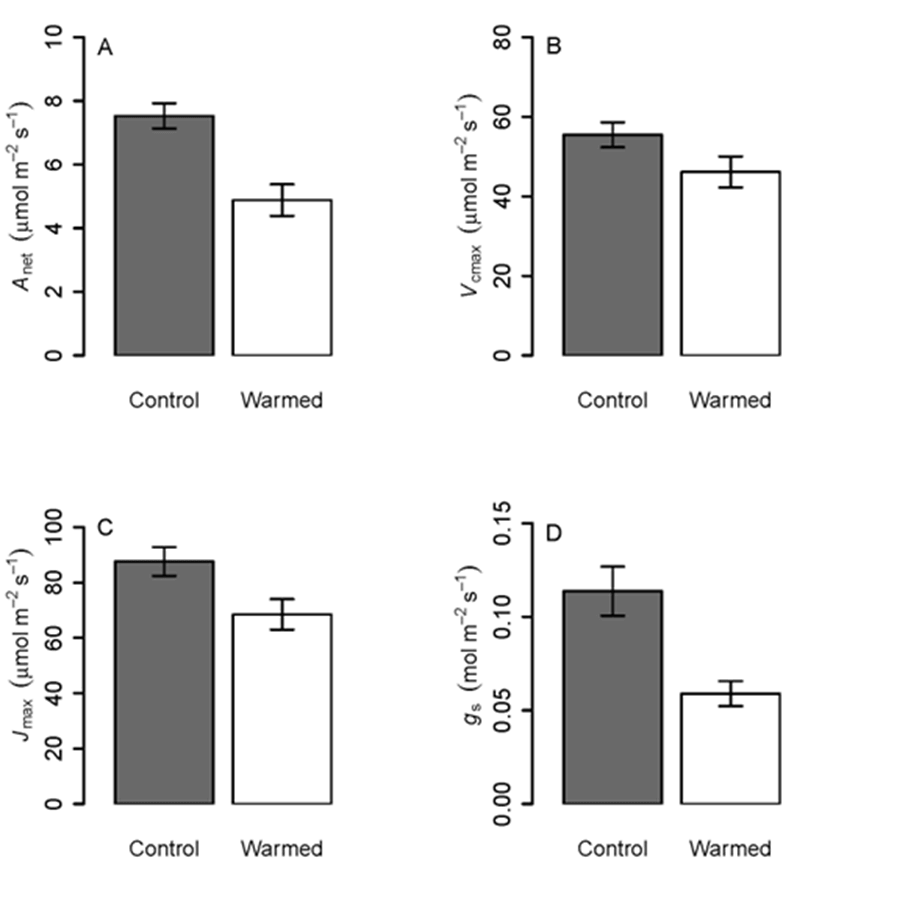
Figure 4. Some results of the experiment across the four species and measurement campaigns for a) net photosynthesis, Anet, b) maximum carboxylation rate, Vcmax, c) maximum electron transport rate (Jmax) and d) stomatal conductance, gs.
For more detailed analyses, please refer to the published article of Crous et al. 2025
The results were very consistent across the four tropical tree species measured. We found a 35% decrease in photosynthesis rates and a 48% decrease in stomatal conductance. There also was a 28% reduction in photosynthetic capacity, measured via the maximum rate of carboxylation (Vcmax) and the maximum rate of electron transport (Jmax) (Figure 4). Overall, the statistics showed that photosynthetic capacity responded to warmer temperatures whereas stomatal conductance likely responded to the higher VPD caused by the warming. Interestingly, the temperature optimum of photosynthesis and respiration rates did not adjust much to warming, which generally are two classic indicators of thermal acclimation (i.e. in the form of an upward shift in temperature optimum and reduced respiration rates with warming). The combination of lower photosynthesis rates, compared with little to no acclimation does not bode well for the future of the tropical rainforest in a warmer climate. Based on these results, we would predict less carbon uptake via photosynthesis with warming, likely resulting in a slower growth rate and weaker sink strength in rainforest with future warming. This corroborates other studies reporting negative effects on tree growth in response to high daytime temperatures (O Sullivan et al. 2020) or higher mortality rates in response to increased VPD (Bauman et al. 2022).
There have only been a handful of warming experiment in mature trees (Slot et al. 2014, Doughty 2011, Carter et al. 2021), mostly due to logistical challenges, but there are clear and consistent warming responses at the leaf scale in the natural setting of a mature forest. Since then, leaf heater experiments have been set up in the Democratic Republic of Congo via the Congoflux site (https://www.ugent.be/bw/gct/en/research/isofys/projects/yps-congoflux ) and at Smithsonian Tropical Research Institute in Panama (https://stri.si.edu/ ). There is further interest from European temperate regions and other tropical forests, creating a network of international collaboration across trees and regions. This technique may open the door for a new generation of warming experiments, and can be combined with other treatments such as elevated CO2 plots (such as FACE experiments) or nutrient gradients.
Click HERE to read the published manuscript
References used:
- Bauman D, Fortunel C, Delhaye G, Malhi Y, Cernusak LA, Bentley LP, Rifai SW, Aguirre-Gutierrez J, Menor IO, Phillips OL et al. 2022. Tropical tree mortality has increased with rising atmospheric water stress. Nature 608:528–533.
- Carter KR, Wood TE, Reed SC, Butts KM, Cavaleri MA. 2021. Experimental warming across a tropical forest canopy height gradient reveals minimal photosynthetic and respiratory acclimation. Plant, Cell & Environment 44: 2879–2897.
- Crous KY, Cheesman AW, Middleby K, Rogers EIE, Wujeska-Klause A, Bouet AYM, Ellsworth DS, Liddell MJ, Cernusak LA, Barton CVM. 2023. Similar patterns of leaf temperatures and thermal acclimation to warming in temperate and tropical tree canopies. Tree Physiology 43: 1383–1399.
- Doughty CE. 2011. An in situ leaf and branch warming experiment in the Amazon. Biotropica 43: 658–665.
- Hubau W, Lewis SL, Phillips OL, Affum-Baffoe K, Beeckman H, Cuni-Sanchez A, Daniels AK, Ewango CEN, Fauset S, Mukinzi JM et al. 2020.
- Asynchronous carbon sink saturation in African and Amazonian tropical forests. Nature 579: 80–86.
- O’Sullivan OS, Heskel MA, Reich PB, Tjoelker MG, Weerasinghe LK, Penillard A, Zhu LL, Egerton JJG, Bloomfield KJ, Creek D et al. 2017. Thermal limits of leaf metabolism across biomes. Global Change Biology 23: 209–223.
- Slot M, Rey-Sanchez C, Gerber S, Lichstein JW, Winter K, Kitajima K. 2014. Thermal acclimation of leaf respiration of tropical trees and lianas: response to experimental canopy warming, and consequences for tropical forest carbon balance. Global Change Biology 20: 2915–2926.
Student Contribution Opportunities
We actively seek student contributions for upcoming Phytogen editions. Student contributions provide a valuable platform to showcase research progress, share insights from conference presentations, and highlight innovative methodologies or preliminary findings. These contributions serve multiple purposes: they enhance student research profiles, facilitate knowledge exchange within the plant science community, and provide networking opportunities with established researchers.
Student contributions can take various forms, including research project summaries, conference experience reports, methodology descriptions, or reflections on research journeys. We encourage contributions from students at all levels, from Honours projects to PhD research. The informal format allows students to present their work in an accessible manner while demonstrating their research communication skills.
Previous student contributors have reported increased visibility for their research and valuable feedback from the broader ASPS community. These contributions often lead to collaborative opportunities and professional connections that extend beyond the publication.
If you are interested in contributing to Phytogen as a student, please contact our editors with a brief outline of your proposed contribution. We provide editorial support to ensure your submission effectively communicates your research to the diverse ASPS membership.
Editors’ Note
Thank you for reading!
We hope you’ve found Dr. Crous’s insights into tropical rainforest climate adaptation research particularly valuable. With conference registration deadlines approaching and abstract submissions closing in early October, we encourage all members to think about their conference participation plans. Stay tuned for our September issue, which will feature updates on conference logistics and additional research contributions from our discipline representatives.
Newsletter written & edited by Lucas Auroux and Razlin Azman.
Invited contributions: Dr. Kristine Crous. We thank all contributors for their continued commitment to advancing plant science communication within the ASPS community. We would also like to thank the ASPS Conference 2025 organising committee for all the work they are doing to put together this year’s conference.